
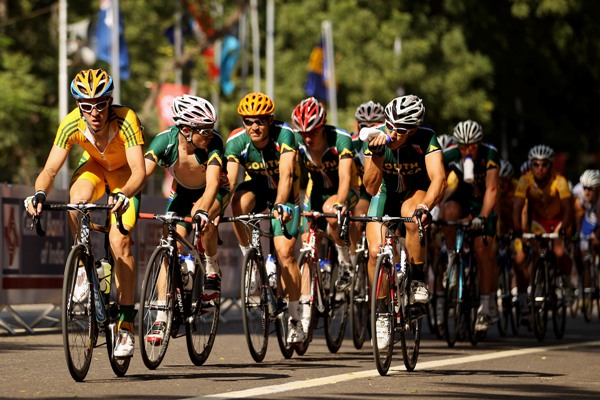

Triple World Champion track cyclist Cameron Meyer has capped off an exceptional year by being crowned the 2010 Western Australian Institute of Sport (WAIS) Athlete of the Year in front of 500 guests at the 2010 WAIS Annual Dinner, held at Challenge Stadium on Saturday evening.
The dual WAIS-Australian Institute of Sport scholarship holder claimed the prestigious title ahead of World Cup winning Kookaburra Graeme Begbie, World Championship silver medal winning gymnast Lauren Mitchell and world indoor pole vault champion Steve Hooker.
Meyer earned the award after producing a dominant display at March’s World Championships in Poland, retaining his points score title, before adding rainbow jerseys in the madison and teams pursuit. The 22 year-old also excelled on the road, winning a national title in the time trial and securing two top 10 placings in the time trial stages of the Giro d’ Italia for his professional road team Garmin-Transitions.
Later in the evening the Western Australian Hall of Champions welcomed two new members to its exclusive club with wheelchair racing great Louise Sauvage and dual AFL premiership champion Peter Matera inducted into the elite of Western Australian sport.
In an international career that spanned 14 years, Sauvage won nine gold and four silver medals across four Paralympic Games. She set world records in various events from 100m to 5000m and won numerous marathons worldwide, including multiple victories in Boston, Honolulu and Berlin.
Matera was an exceptionally gifted footballer, he was West Coast’s main attacking weapon during the club’s golden reign under Mick Malthouse in the early to mid 1990s. Matera’s career spanned 253 games, and included two premierships and five all-Australian selections. The wingman is the first footballer who played his entire career with the West Coast Eagles to be inducted into the Hall.
Also present on the night were the WAIS Athlete with a Disability of the Year and WAIS Junior Athlete of the Year awards.
Wheelchair basketball athlete Shaun Norris won the WAIS Athlete with a Disability of the Year following what was arguably his best season on court for the Australian Rollers and Perth Wheelcats. Norris played a crucial role in Australia’s World Championship win and starred in Perth’s fifth straight national title. He was named the Midpoint MVP, overall MVP and finals MVP and was crowned the best player in the world in the 3.0 point disability category. Norris received the award ahead of Rollers teammate Justin Eveson and IFDS Sailing World Championship silver medallist Rachel Cox.
Luke Durbridge reinforced his growing reputation by winning a second successive WAIS Junior Athlete of the Year award after winning a silver medal in the Under-23 time trial at the UCI World Road Cycling Championships in Melbourne, at just 19 years of age, becoming the youngest cyclist to medal, eclipsing by 33 days the record previously held by world champion Fabian Cancellara.
The Western Australia Hall of Champions elevated two new legends on Saturday night with Graeme “Polly” Farmer and Denis Lillee becoming the third and fourth respective athletes to be bestowed legend status.

Raised in the Sister Kate’s Orphanage at Queen’s Park, in suburban Perth, Graeme Farmer broke the shackles of his Aboriginal background to emerge as the dominant man in the game, nationwide, for nearly two decades. A superb, high-leaping ruckman, Farmer revolutionized the game with his use of handball in Western Australia and then Victoria.
It was a little-used art in the early 1950s when Farmer perfected ruck tactics, handballing while still airborne.
Farmer was developed at East Perth in the mid-1950s when coach Jack Sheedy instigated the Royal’s revival, building a superb team around the big man and his ability to feed the handpass out to running players.
Farmer’s individual dominance was evident in 1956 when he won his first Sandover Medal as the fairest and best player in the WA Football League. He won a second Sandover Medal in 1957 and a third in 1960. He was runner-up for the award twice. A Tassie Medal for the best player in an Australian Championship was won in 1956 and Simpson Medals came in 1959 (best player in the grand final) and in the interstate arena in 1956, 1958 and 1969. That last medal win, achieved in an Australian Championship at the age of 34, was regarded as one of his greatest games.
Fairest and best wins for his clubs came frequently – at East Perth in 1954-55-56-57-59-60-61; at Geelong in the Victorian Football League in 1963-64 and then as captain-coach West Perth in 1969. Farmer played a total of 356 club matches (East Perth 176, Geelong 101, West Perth 79) and 36 State games, five with Victoria.
He played in Premiership teams with all three clubs (East Perth, 1956-58-59; Geelong 1963 and West Perth 1969-71). After returning as a player in 1971 he returned to coach Geelong (1973-75) and East Perth (1976-77). In 1988 he returned to the VFL arena as an assistant coach of the West Coast Eagles.

One of the most fearsome and complete fast bowlers of all time, Dennis Lillee finished a glittering career as the world record wicket-taker with 355 Test victims.
He first played for Western Australia in 1969 and began his illustrious Test career in the same series (1970-71 against England in Australia) as another great WA Test representative, wicketkeeper Rod Marsh.
Marsh stood behind the stumps in all of Lillee’s 70 Test matches and the pair enjoyed success unparalleled in the history of Test cricket. When both retired after the 1983-84 season, they had combined in 95 Test dismissals – more than double the number of any other bowler-wicketkeeper combination.
Lilliee’s career came to a sudden halt in 1973 when he suffered stress fractures of the lower lumbar vertebrae.
He missed the 1973-74 season, but such was the intensity of his build-up to the 1974-75 season that he was able to return stronger and better than ever, teaming with Jeff Thomson to form one of modern cricket’s most devastating fast bowling duos.
Throughout his career, Lillee was recognized as one who gave maximum effort for the team cause. A charismatic figure with a characteristic moustache, he was both feared and revered for his near mastery of the craft of fast bowling. Lillee compensated for the natural loss of speed by developing a repertoire of deliveries which coupled with superb control and an aggressive approach, made him even more successful.