
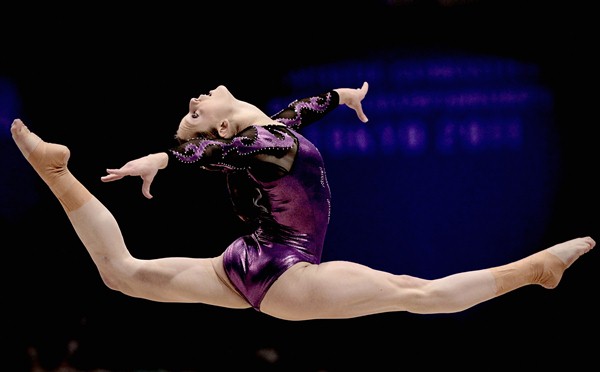
Lauren Mitchell has created another piece of history for herself after becoming the first gymnast to win the prestigious Western Australian Institute of Sport Athlete of the Year Award at the 2011 WAIS Annual Dinner.
Mitchell was crowned the Institute’s best athlete in front of 500 guests at a gala dinner held at Challenge Stadium, with awards also presented to fellow athletes cyclist Luke Durbridge (Junior Athlete of the Year) and Sharon Jarvis (Elite Athlete with a Disability of the Year). Also honoured were three new inductees, gymnast Allana Slater, footballer Denis Marshall and harness racer Chris Lewis, and the elevation of the fifth champion to Legend status, billiards champion Walter Lindrum, within the WA Sporting Hall of Champions.
Athlete of the Year Mitchell, in the course of the October 2010 to September 2011 voting period, became the first Australian female in history to win a FIG World Championship gold medal, after claiming the floor title in Rotterdam, the Netherlands, straight off the back of winning four gold medals at the 2010 Commonwealth Games in India.
The 19 year-old joint WAIS-AIS scholarship holder won the award ahead of stellar field of finalists that included World Champions; Luke Durbridge (cycling), Cameron Meyer (cycling), Susan Fuhrmann (netball), Caitlin Bassett (netball), Todd Skipworth and Ben Cureton (rowing) and Commonwealth Games champion swimmer Blair Evans.
Despite missing out on the WAIS Athlete of the Year Award, 20 year-old Luke Durbridge created his own slice of history after becoming the first athlete to win the WAIS Junior Athlete of the Year Award three years in a row.
Durbridge won a senior world title in March at the UCI Track World Championships in the Netherlands, forming part of the triumphant Australian Teams Pursuit quartet that claimed gold over Russia. Durbridge followed that success by winning the U23 World Time Trial title at the UCI Road World Championships in Denmark last September.
The WAIS Elite Athlete with a Disability Award was won by equestrian athlete Sharon Jarvis, who enjoyed an outstanding year. This award followed a double bronze medal winning campaign at the 2010 World Equestrian Games in Kentucky, United States after travelling 26,000km from Donnybrook just to compete.
The 2011 WAIS Annual Dinner also saw three new inductees into the WA Sporting Hall of Champions, with gymnast Allana Slater, Australian Rules Footballer Denis Marshall and Harness Racing great Chris Lewis honoured in front of 500 guests.
Slater, was a trail blazer in Australia’s bid for prominence on the world gymnastics scene.
In 1999 she was the first Australian to be placed in the top ten in the World Championships when achieving this in China. Between 2000 -2003 Slater won nine medals at World Cup events in several disciplines. She also won eight Commonwealth medals, including three Gold. She is the first gymnast to be inducted into the hall.
Marshall, was a classical utility player for Claremont and Geelong. Marshall excelled in interstate football for both Western Australia and Victoria. Well balanced and with exquisite skills on both sides of his body, Marshall was regarded as the complete footballer. He was runner up in the Sandover Medal in 1962 and the Brownlow Medal in 1968. Marshall played 24 interstate matches, 16 for WA and 8 for Victoria. He was voted in Geelong’s best three players of the 20th century.
Lewis was born in North Adelaide on August 1, 1955 but moved to Western Australia at age 20 to begin a career which saw him become arguably WA’s greatest trotting reinsman. He has driven over 4000 winners in WA, 2000 of those on city tracks. A winner of Interdominion races, Lewis will represent Australia again in 2011 in the World Driver’s Championships in the USA.
One of the highlights of the evening came when the late Walter Lindrum was announced as the fifth elevation to legend status on the WA Hall of Champions, joining WA sporting icons Herb Elliot, Shirley de la Hunty, Graham Farmer and Dennis Lillee.
Christened Walter Albert so that his initials depicted his WA background, he was a proud Western Australian who went on to win the world professional billiards title in England in 1933 and defend it successfully in Australia a year later.
Lindrum, who made his first 100 break at the age of 12 and first 500 break at 14, displayed freakish ability with the cue, compiling 711 breaks of 100 or more, 29 in excess of 2000 and topping 3000 17 times. In January 1932, in a match against reigning world champion Joe Davis, in London, Lindrum compiled a world record break of 4137, which included 15 sequences of nursery cannons to accumulate 2578 of his points.